
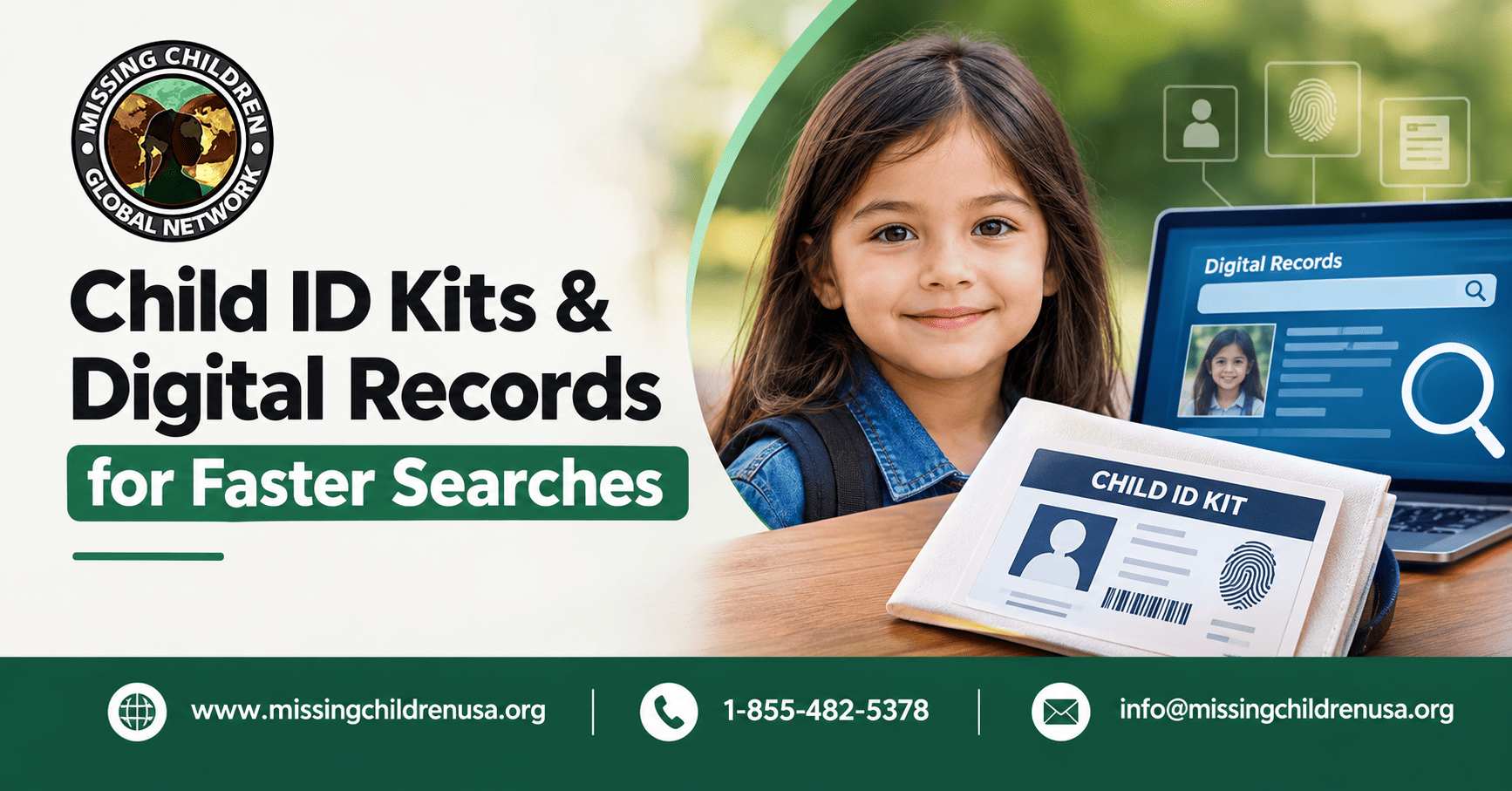
Most parents would assume they have their records of their children’s appearance prepared in the event their child goes missing. But when an investigator asks for an updated photo, a physical description or other details, parents realize they aren’t as prepared as they thought they were.
Creating a child ID kit helps families and law enforcement when the unimaginable happens. Missing Children Global Network knows first-hand how a prepared, up-to-date record helps an investigator kickstart their search for a missing child.
What is a digital record and child ID kit?
To ensure quick action from law enforcement, a child ID kit should be filled with everything they could need.
A child ID kit usually includes an updated picture of the child, taken within the last 3 months, a physical description of the child, including height, weight, eye, and hair color, plus a scan of fingerprints. In addition to an ID kit, creating a digital record is also crucial to give a law enforcer any additional information that wouldn’t be included in a paper kit. Things like social media or apps the child is active on, their school email, and any other identifying information could help narrow down a search for digital footprints. Especially for teenagers, the first place to find them could be online, so having this information on-hand to share could be the beginning of a successful search.
Other information to keep in the kit or on a digital record includes emergency contacts, medical records, or other notes on conditions that may be relevant to finding the child. Finally, some conditions might impact how a child communicates or acts, which can help narrow down a search.
How Having Updated Records Helps the Investigator
Children change rapidly, and having a picture from 18 months before the initial report could be outdated at best. In 18 months, a child could be an entirely different height or weight. They could have different-colored or different-length hair. For young children, these changes can accelerate, and they may appear almost unrecognizable as they grow.
Having updated information on-hand means that as soon as law enforcement gets the initial report, they can begin the search, knowing they have the most recent appearance of the child. This way, alerts go out faster, and the public gets an up-to-date picture as soon as possible in the search. Police may react quickly without requesting further information after the initial report if they have up-to-date images, descriptions, and fingerprints. A lack of this information has been known to prolong a search, and the slower a response, the lower the chances of a return.
Best Practices for Keeping the Records Updated and Safe
A good rule of thumb is updating the records every six months. For younger children, it’s always best to update more frequently if their appearance changes. One easy way to remember to do this is to update records on a child’s birthday, and again six months later. Keep in mind that you should store records safely somewhere secure in your home, and backed up digitally in a safe encrypted file that only you can access. Avoid keeping documents that include vital and identifying information in a shared space like a family photo album or insecure online space.
Keeping updated records of your child also holds true at a school or daycare if they have a file on your child already. If not, it’s always a good idea to give them an updated photo and list of emergency contacts to have on file if something does happen.
Frequently Asked Questions (FAQs)
- What is a child ID kit?
A child ID kit is a set of records and information about your kid that a law enforcement officer can utilize in the event that your child disappears. It usually includes an updated picture, a physical description, and fingerprints.
- What details must be included in a kid ID kit by parents?
Parents should include a current picture (within 3 months), a thorough physical description of the kid, fingerprints, medical information, school records, and social media or app activities for older children.
- How often should parents update child identification records?
Every six-month mark, parents should update their child’s identification records. Parents of younger children should update every quarter. It’s a good idea to schedule record updates on a child’s birthday.
- Are digital child identification records safe to store?
Digital records should always be kept in encrypted or password-protected files. Avoid sharing these records publicly or keeping them in a non-secure location.
- Can law enforcement locate a missing kid more quickly with the use of a child ID kit?
Yes! Updated records help an investigator begin searching faster, and every second counts when trying to find a missing child who may be in danger.
Creating a child ID kit is something every parent doesn’t want to consider, and that is totally understandable. But to help law enforcers as soon as possible in a search, creating a kit and keeping records updated is one of the easiest ways a family can help. If your family needs support or assistance in keeping records or support in an investigation, Missing Children Global Network is always standing by and working with families and law enforcers to make sure that no stone is left unturned in a search. Find them at 1-855-482-5378 or missingchildrenusa.org.