
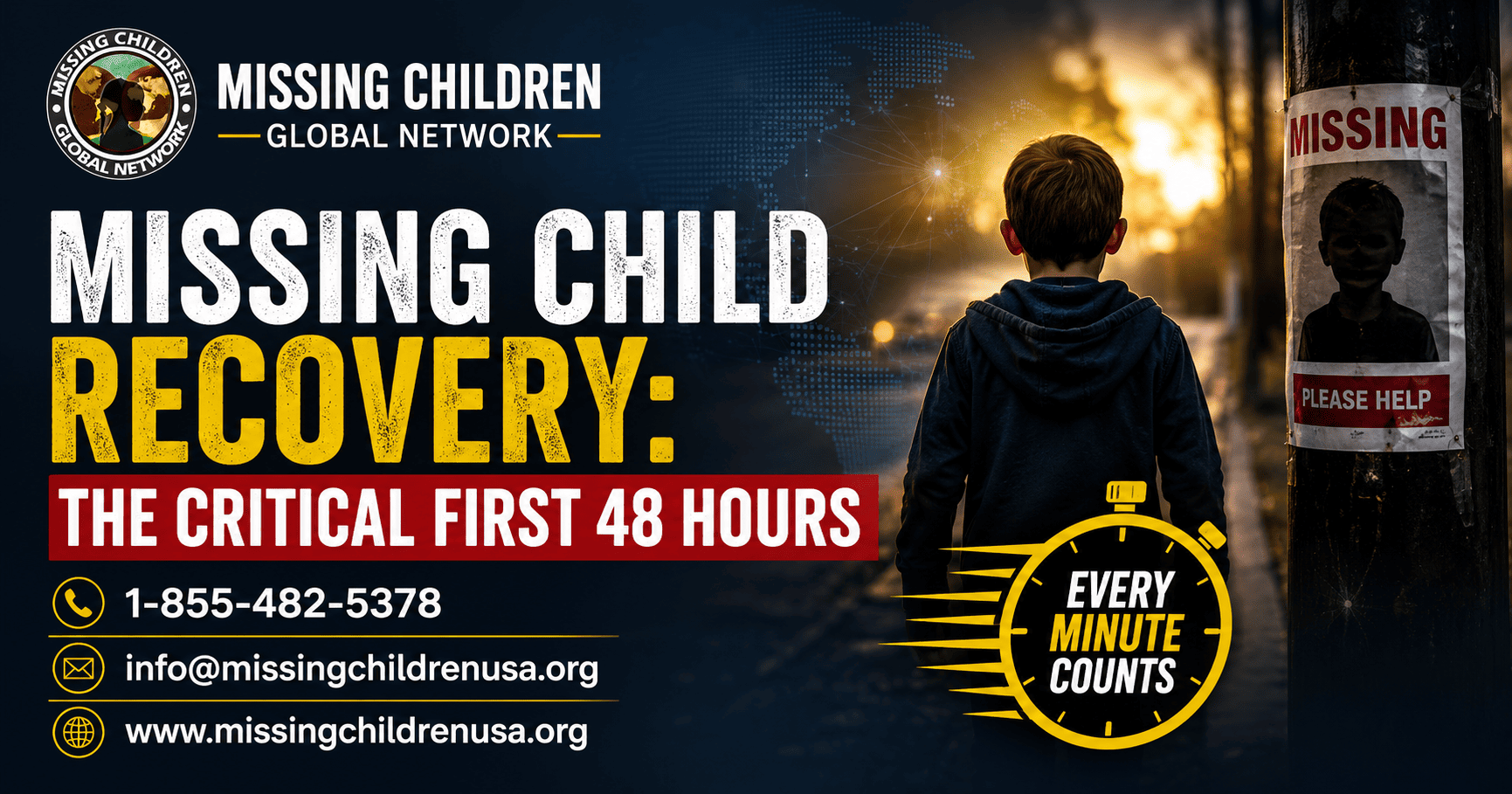
Investigators who work missing child cases will say the same thing almost without exception: the calls they dread most aren’t the ones that come in immediately. They’re the ones that come in two days late, from a parent who spent 48 hours convincing themselves to wait.
By then, the gas station footage has cycled. The neighbor who thought she saw something has already gone back to her routine. She is not sure anymore. That moment of certainty she had is fading. And the family is still stuck somewhere between suspicion and the decision to act, not quite ready to believe this is actually happening.
That gap is where cases fall apart. The Missing Children Global Network steps in right there, not after the family has accepted the worst, but while there is still something to work with.
The Significance of the First 48 Hours
The most usable information often disappears faster than most people expect. Unless someone expressly requests that it be retained, security footage from a neighboring store is erased in 24 to 72 hours, often less. The teenager who noticed something odd near the bus stop on Monday will not remember the same details by Wednesday. What was clear two days ago is uncertain, patchy, and easy to doubt. Physical evidence at the last known location does not wait either, particularly outdoors where weather, foot traffic, and time do their work quickly.
There’s also a quieter problem. Families who haven’t reported yet sometimes begin making informal inquiries on their own, asking around in ways that aren’t coordinated and occasionally alert the wrong people before investigators are even involved.
Reporting immediately changes everything. Law enforcement can pull footage before it’s gone, enter the child’s information into national databases, and reach the public through channels that actually work. There is no required waiting period, no threshold of certainty that must be met first. If something feels wrong, that feeling is reason enough to call.
How Missing Child Recovery Services Improve Recovery Outcomes
There’s a particular kind of paralysis that sets in during these situations. It isn’t indifference. When a brain is challenged to make judgments that seem vast, it is attempting to process something for which it lacks a template. Who needs to know right now? What’s safe to post publicly? Which incoming tips are worth passing to police?
Professional missing child recovery services fill exactly that gap. Instead of taking the place of law enforcement, we should sit with the family to prevent the reaction from being overtaken by pandemonium. Case details get documented properly from the start. Incoming information gets sorted and passed through the right channels. Families aren’t left alone with a phone full of messages and no idea what to do with them.
Knowing that someone experienced is handling the parts you don’t know how to handle makes it possible to keep functioning. And functioning, in those first hours, is itself a form of helping.
The Influence of Law Enforcement and Community Cooperation
Here’s what a missing child response actually looks like from the inside. Law enforcement is running the official investigation. Dozens of people are sharing a photo on social media, some with accurate information and some without. Neighbors are calling the family directly with tips instead of the tip line. A community group is planning a search without knowing where the child was last seen.
All of that is happening simultaneously, and without someone managing it, genuine leads get buried.
Instead of making additional noise, a reputable missing children group influences the current action. Verified information goes to investigators. Community energy gets directed toward efforts that are actually useful. The family has a point of contact instead of managing everyone else while living through the worst experience of their lives. When that coordination works, cases move faster and searches cover ground that matters.
Conclusion
Forty-eight hours is not a long time in most situations. In a missing child case, it’s often the difference between investigators working with strong current evidence and working with whatever survived the wait.
Acting immediately doesn’t require certainty. It just requires making the call before the window closes and getting the right support around the family from the very first hour.
If your child is missing or you know a family in this situation, don’t let another hour pass. Contact law enforcement now, then reach out to Missing Children Global Network for professional investigative support and family guidance throughout the entire process. Visit missingchildrenusa.org today.
Frequently Asked Questions
- Why are the first 48 hours critical when a child goes missing?
Evidence degrades fast. Footage gets recycled, witnesses lose specificity, and physical traces disappear. Investigators working an immediately reported case have access to resources that simply don’t exist two days later.
- Do I have to wait to file a missing kid report?
No. The idea that you must wait is a myth. There is no waiting period. Contact law enforcement the moment something feels wrong.
- What services do missing child recovery organizations provide?
They may offer investigative support, case coordination, family guidance, awareness programs, and assistance while working alongside law enforcement.
- How can communities help find a missing child?
Send credible tips directly to law enforcement. Share only verified official information publicly. Unverified posts feel helpful but create false leads that slow investigations down.
- How does Missing Children Global Network support families?
Through community outreach and more extensive child safety education, as well as free investigative support, credentialed experts, and engagement that lasts beyond the initial days of the case.